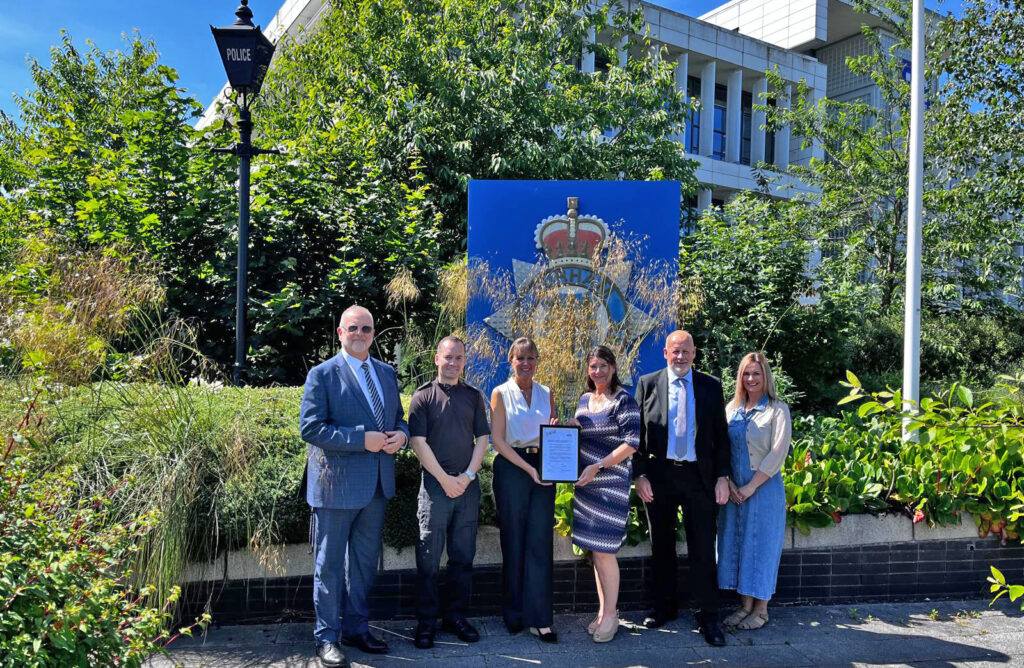
(L-R): Mark Warcup (Operations Manager, OPCC), Superintendent Dean Haythornthwaite, PCC Joy Allen, Angela Denison, Chris Knox, Nicola Gill (Community Protection Area Manager, Durham County Council)
Police and Crime Commissioner Joy Allen has signed the ASB Help Pledge on behalf of partners in the Safe Durham Partnership, Darlington Community Safety Partnership, and Durham Constabulary, confirming their shared commitment to supporting and amplifying the voices of victims of anti‑social behaviour.
Coming in Anti‑Social Behaviour Awareness Week (June 29 July 5), the pledge encourages all agencies involved in the ASB Case Review process to embed best practice within their policies and procedures.
This commitment is shared by a wide range of partners – including local authorities, housing associations, police forces, and other organisations responsible for tackling anti‑social behaviour – all of whom play a role in delivering the ASB Case Review Scheme (formerly known as the Community Trigger).
The ASB Case Review Scheme enables victims who have reported persistent ASB, but are dissatisfied with the response, to hold agencies to account and request a review of their case.
Created by the charity ASB Help, the ASB Help Pledge aims to ensure victims are supported, heard and given consistent access to the Case Review Scheme.
To achieve accreditation, agencies must meet rigorous criteria, including:
- Raising awareness so victims understand their right to request a review.
- Ensuring accessible application processes in multiple formats.
- Demonstrating effective multi-agency collaboration and information sharing.
- Complying with legislation and statutory guidance.
- Maintaining high-quality communication with victims.
- Actively listening to and supporting victims throughout the process.
These measures are designed to ensure a victim-first approach.
The PCC has led the way in strengthening support for victims of persistent ASB for several years. Recently, she introduced significant improvements to the management and administration of the ASB Case Review process to enhance outcomes for victims -well ahead of new statutory requirements.
These improvements include:
- Appointing a dedicated Review Coordinator, funded by the PCC, to provide victims with a single point of contact.
- Recruiting two volunteer ASB Case Review Chairs.
- Introducing a dedicated case management system to improve tracking and efficiency.
The Commissioner has been tireless in her work to address problems associated with anti-social behaviour, which has been consistently prioritised by residents as a key concern in her regular consultations.
During its design and implementation, the PCC’s Operations Service Manager worked closely with the force to ensure the system can identify cases requiring support and those meeting the threshold for a case review.
Commenting on the accreditation, Joy Allen said: “The Pledge is testament to the dedication, passion and hard work of my ASB Champion, my wider team and our partners.
“It has taken several years of investment, research and sustained effort to reach this point. We have remained determined to see victims of ASB receiving unparalleled support – well beyond what is expected.
“This pledge strengthens our determination to go further, ensuring County Durham continues to lead the way in delivering the care, respect and service victims deserve.”
Supporting and Championing Victims is the first of six priorities in the PCC’s Police, Crime and Justice Plan, underlining the Commissioner’s commitment to placing victims at the heart of all services. This pledge to deliver a first-class service for victims is strongly shared by the Chief Constable.
The PCC is one of the first in the country to offer ASB victims the opportunity to attend case reviews and provide statements outlining the impact on their lives. Under new guidance, agencies are encouraged to involve victims in reviews and to provide a single point of contact.
She was also the first PCC to appoint a dedicated Anti-Social Behaviour Champion to support victims and lead research into the victim journey through the justice system. Many of her wider priorities reflect the findings of the late Baroness Newlove, former Victims’ Commissioner for England and Wales, in her report on ASB.
Chris Knox, Head of Community Safety, Darlington Borough Council, said: “It is a testament to the partnerships and the work that is already done around anti-social behaviour that across County Durham and Darlington we have been successful in meeting the standards to be accepted for the ASB Help Pledge.
“In Darlington ASB has been identified as a priority for the Community Safety Partnership and the pledge will strengthen the support, we give victims moving forward and assist our quest to deal with such issues”.
Superintendent Dean Haythornthwaite, head of neighbourhood policing for Durham Constabulary said: “Everyone has a right to feel safe in their community and tackling antisocial behaviour remains a priority for Durham Constabulary.
“We understand the impact antisocial behaviour can have on communities and are committed to responding where concerns are raised.
“We are seeing positive results from our neighbourhood policing approach – reported crime is down and we have recently introduced an additional 26 officers into our neighbourhood teams to tackle crime and antisocial behaviour.
“The ASB Help Pledge will help to strengthen the support provided to victims of antisocial behaviour from ourselves and our partners, ensuring that victims’ voices are heard and acted upon.”
Angela Denison, Victim and Partnership Project Manager at ASB Help said: “Anti-social behaviour (ASB) can have a debilitating impact on a victim’s health and well-being and a devastating effect on the wider community.
“There are many effective legal and non-legal tools to address ASB and these are used by organisations such as local authorities, police, and housing providers throughout the UK. Unfortunately, there are times when despite the victim reporting these incidents to various agencies, the ASB persists. It is in these circumstances whereby the ASB Case Review proves to be an invaluable tool.
“As straightforward as this may sound, we have seen differences across England and Wales in the administration and delivery of the ASB Case Review process where ultimately it is the victim who is affected as a result.
“In response to this inconsistency, we at ASB Help launched The PLEDGE, which seeks to encourage all agencies involved in the ASB Case Review process to embed best practice into their policy and procedures. This helps us in our mission to ensure that the ASB Case Review is not a postcode lottery and that any victim of persistent ASB (when the threshold is met), regardless of where they live, are truly given a voice and partners work together, and problem solve to secure a satisfactory resolution.
“By signing up to our ASB Help Pledge, we will work with partners to ensure that they demonstrate their commitment to supporting victims of ASB, and will endeavour to implement and follow best practice with the ASB Case Review. It is evident from case studies we see that partnership working is vital to the successful management of ASB cases, and subsequently for a positive approach to ASB Case Reviews.
“ASB Help are delighted that Durham Police and Crime Commissioner on behalf of Darlington Community Safety Partnership, the Safe Durham Partnership and Durham Constabulary has signed up to our ASB Help Pledge which demonstrates their commitment in supporting partners in promoting best practice for the ASB Case Review. In doing so they are ensuring that victims of ASB in the region have a voice.”