Harperley soldier whose sculpture is a tourist attraction in Barbados
THE work of a man born and bred at Harperley Hall in Weardale who served in the British Army
for over 30 years and was also an artist, is a popular tourist attraction in Barbados.
Henry John Wilkinson was the son of George Hutton Wilkinson, a judge and owner of
Harperley Park who helped to bring the railway to Weardale. Another of George’s sons – the Rev
Thomas Wilkinson built the Catholic church and convent in Wolsingham. He would later become
the Bishop of Hexham and Newcastle and the founder of the Crook and Tow Law Parishes.
Henry John Wilkinson, meanwhile, was serving as a Captain in the 9 th Regiment of Foot (the
Norfolk Regiment), which took him to Barbados at one point. He was also a very talented artist –
a self-taught painter, portrait artist and sculptor.
Henry was promoted to Captain on 6 th January 1855. On 1 st April, 1870 he was promoted to
Major and he was subsequently made an Honorary Colonel and retired in 1877. Throughout the
course of his career he served in Ireland, Crimea, Malta, Canada and Bermuda as well as
Barbados.
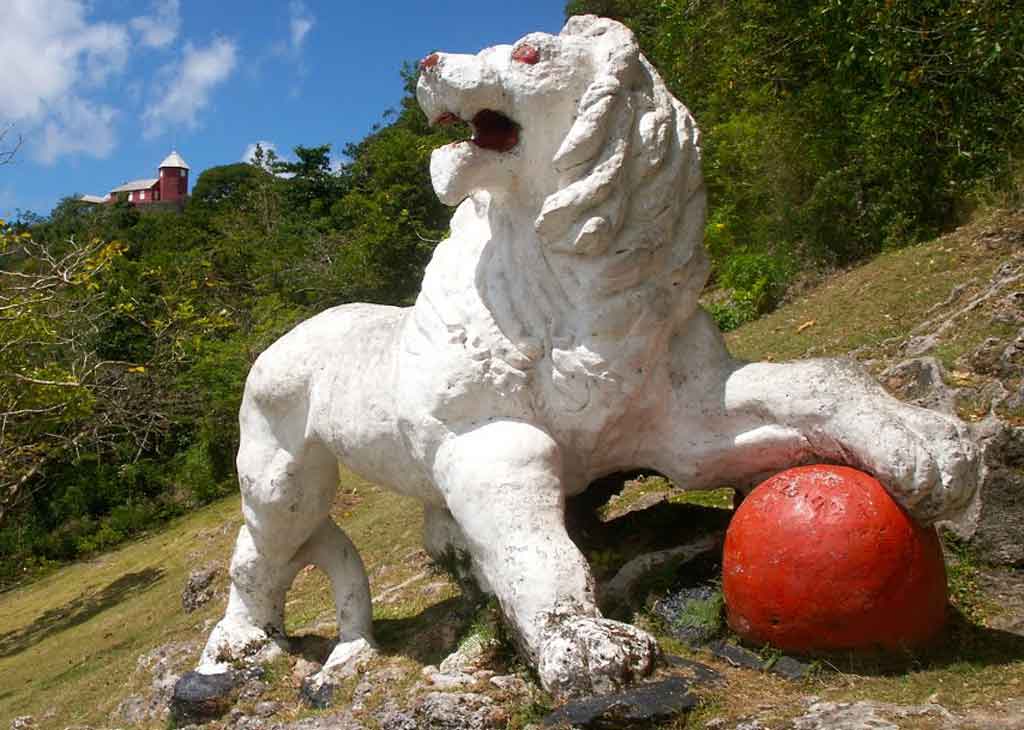
In 1868, while serving there, he spent his spare time carving a huge white lion – seven feet
long – from a single piece of Coral, aided in his task by four of his men as military labourers. It
was placed near the Gun Hill Station, presumably the barracks of this regiment, over looking the
sea at St George. Since the day it was placed there, it has been a popular ‘must-see’ for natives
of the island and also for visitors. It is thought that the lion was sculpted over a period of time,
perhaps a few years.
A prolific artist, in Crimea (1854/55), Henry sketched and painted many scenes from the
campaign, in particular, the Siege of Sevastopol.
A number were published as lithographs in The Illustrated London News, founded in 1842.
The publisher would take original paintings and have them engraved in wood as stamps for
printing. This often required some simplification from the original so they would print clearly.
Many of Wilkinson’s military paintings are held at the National Army Museum, in London
Henry and his wife lived in Barbados from 1863 and where two of his eight children were born
and baptised. He would later live in Italy where they both died and are buried but it is not clear or
recorded if he ever returned home to Harperley.
With the lion staring out toward the sea, its upraised left front paw resting on a large round
ball, it has been conjectured there is another meaning for the quotation that is on the sculpture
(He will rule from sea to sea from river to the ends of the earth)– that being the power and
scope of the British Empire around the globe at the time. The sculptor was a lifelong military
man having already served in at least four countries before his arrival in Barbados, so he
probably had a strong loyalty to crown and empire.
For almost 160 years, the name of Henry John Wilkinson, whose grandparents’ portraits still
hang to this day in Harperley Hall Police College has been read and admired by visitors and
locals alike.
He was a Weardalian whose story has never been fully told to the world or even known to local
people.