The Finchale Camino Inglés
By Keith Taylor
In your area, and especially near Durham City, you may well see a sign like the one shown here. As you will see, it has the symbol of a shell and the wording ‘Camino Ingles to Santiago.’ What is this all about? Here is an explanation which goes back a long way!…
One of the most famous pilgrimage routes in the world is the Camino de Santiago in Spain. Santiago de Compostella is a city in the northwest of Spain. It follows an earlier Roman Trade Route. The story of how the city got its name is a very interesting one…
San Tiago translates from Spanish to English as the name of the disciple St James. St James was one of the twelve apostles chosen by Jesus Christ to share his message. Saint James travelled to northwest Spain (which was called ‘Finis Terrae’ – ‘the end of the world’ by the Romans) to preach and convert people to Christianity. After St James returned to Palestine in 44CE, he was tortured and beheaded by King Herod Agrippa. The king refused to bury him, but his friends put his body in a coffin in a small stone boat and after a long time, it was carried by the currents back to the northwest of Spain. The coffin was buried in a secret place in a large wood. He had arrived again at the place where Jesus had chosen for him to go and preach the Gospel.
Many years later in 813 a hermit called Pelayo was in the wood and he heard music and saw a bright shining light. Because of this shining the place was called ‘Campus Stellae’ – ‘field of stars’ and in Spain this became Compostella. It is believed that this is the Milky Way.
The local bishop heard about the hermit’s vision and ordered a search to be made and Saint James’s coffin was soon found. The king called Alphonse II declared that St James would be the patron saint of Spain and a chapel was built there. Soon miracles were reported at the shrine and pilgrims started to go there. Eventually this developed into ‘The Camino de Santiago’ – ‘The Way of Santiago.’ In place of the chapel, a fine cathedral was built which became the centre of the city of Santiago de Compostella.
In the Middle Ages rich people used to send their servants in their place on pilgrimages. They believed that this meant they would have easy access to Heaven.
The number of pilgrims varied over the centuries, but they increased hugely in the late 20th century and up to the present time. In 1985 only 2,500 people walked the Camino, but by 2018, the number of pilgrims was 327,342! And now there are many, many more. In 2024 there were 499,239 official pilgrims walking but many more walked unofficially.
Here is a group of modern-day pilgrims in front of Santiago Cathedral.
The Scallop Shell
The scallop shell is the main symbol connected with the Camino and once again there’s at least one story to explain how this came about.
This is one of the stories. When the boat carrying the coffin with St James’s body came towards the shore in Spain, a knight was riding by. When the horse saw the boat it suddenly bolted and plunged into the sea with the knight, but a miracle occurred, and the knight and the horse came up out of the sea covered in scallop shells!
How the body of St James got to Spain is a mystery. It is said that after James’s death, his disciples shipped his body to the Iberian Peninsula in a stone boat to be buried in Galicia. It has also been said that an angel looked after the boat, rather than some of his followers, and led it to Northern Spain. Off the coast of Galicia, a heavy storm hit the ship, and the body was lost to the ocean. After some time, however, it washed ashore undamaged, covered in scallops.
The scallop shell then became the symbol of St James and when pilgrims started to come to the shrine of St James, the tradition developed for them to wear shells on their clothing to indicate that they were genuine pilgrims. Pilgrims often took a scallop shell also to drink water from, to cut things with its sharp edges or receive gifts for their journey. The grooves in the shell, which meet at a single point, represent the various routes pilgrims travelled, eventually arriving at a single destination: the tomb of James in Santiago de Compostela. It was also used by early pilgrims to scoop water from streams and even to eat from. The shell also gave them privileges to sleep in churches and hostels. Modern day pilgrims often carry Scallop Shells on their rucksacks. Sometimes, in Cities, they set in the road and are used to guide the way.
St James is recognised as being the Patron Saint of Pilgrims. He is often pictured with his symbols, the scallop shell, a hat and a staff. He sometimes carries a drinking bottle too.
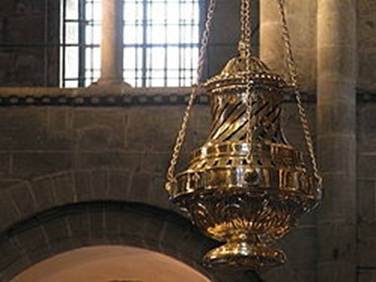
Pilgrims became very dirty and had few opportunities to wash themselves or their clothes! On one of the Caminos, the French one, there is a place called Lavacolla, which is very near to the Cathedral at Santiago. This translates as wash your neck and was where pilgrims often cleaned up before they went on to Santiago. Another thing that was used to disguise the small of the pilgrims and the celebrate the Holy Mass was the Botafumeiro. This is a giant thurible or censer. It’s 1.5m high, weighs 10kg when full, hung on a 65m long rope suspended from the ceiling of the cathedral. It reaches 65km/hr when swung and takes six men to swing it.
The route is marked by moutieros in Spain, stone obelisks, which often tell you how far you still must walk to get to Santiago. We now have our own mouteira at Finchale Priory where the Camino begins in England. Here is a photo of the Chair of the Organisation taken when the mouteira was installed.
In Spain you might also see yellow arrows
painted on stones to help to guide you.
People who went on pilgrimages from Britain to Spain mostly travelled by sea from ports in south-west England and then landed at ports on the north coast of Spain to finish their journey on foot. The routes eventually became known as ‘The Camino Ingles’ or ‘The English Way.’ The official Camino Ingles route in Spain now starts at either A Coruña or Ferrol and they both join up at a place called Bruma just north of Meson do Vento on the map. The route from Ferrol is 118 Kilometres and the one from A Coruña is only 75 kilometres.
When pilgrims arrive at Santiago they like to receive a special certificate which is called a compostela, but you need to have walked a minimum of 100 kilometres to get your compostela. To earn the compostela one needs to walk a minimum of 100 km or cycle at least 200 km. Another way of writing it. Most pilgrims carry a document called the credencial, purchased for a few euros from a Spanish tourist agency, a church or parish house on the route, a refugio, their church back home, or outside of Spain through the national St. James organization of that country. The credencial is a pass which gives access to inexpensive, sometimes free, overnight accommodation in refugios along the trail. Also known as the “pilgrim’s passport”, the credencial is stamped with the official St. James stamp of each town or refugio at which the pilgrim has stayed. It provides pilgrims with a record of where they ate or slept and serves as proof to the Pilgrim’s Office in Santiago that the journey was accomplished according to an official route, and thus that the pilgrim qualifies to receive a compostela (certificate of completion of the pilgrimage).
Most often the stamp can be obtained in the refugio, cathedral, or local church. If the church is closed, the town hall or office of tourism can provide a stamp, as can nearby youth hostels or private St. James addresses. Many of
the small restaurants and cafes along the Camino also provide stamps. On the Camino Inglés in Durham the Cathedral, Finchale Priory, Auckland Castle, Durham Cathedral and many other places have stamps.
Here is part of a poem written over 300 years ago by the famous Sir Walter Raleigh:
Give me my scallop shell of quiet,
My staff of faith to walk upon,
My scrip of joy, immortal diet,
My bottle of salvation,
My gown of glory, hope’s true gage,
And thus I’ll take my pilgrimage.
The Local Connection

About 900 years ago a person called Godric made a pilgrimage to Santiago. He also went to Jerusalem and Rome on pilgrimage. He later settled as a hermit by the River Wear at Finchale which is about four miles north of Durham. There’s a beautiful, ruined priory there and it’s well worth a visit. Here he lived to be a hundred which was very, very rare in those days. Many people used to come for his advice about many things and this included pilgrims who wanted to receive his wisdom and his blessing before they set out for Santiago. He would warn them of the problems that other pilgrims had had: Disease, getting lost, finding places to sleep, thieves and robbers and of course sore feet and blisters. The Camino was then along a trading route but is now well-marked and easy to follow either with the image of a scallop shell or a yellow arrow.
Godric was born at Walpole, Norfolk, around 1070. He had humble beginnings. When he grew up, he had many jobs. He was a peddler selling things around villages and towns. Later he became a sailor, and it has been thought that he might have been a pirate for some time. When he went to Lindisfarne (Holy Island) he was converted to Christianity. In a vision, Saint Cuthbert promised Godric a hermitage. After spending some time in Wolsingham with a hermit named Aelric, the Bishop of Durham allowed him to move to where he spent the last sixty years of his life as a hermit at Finchale.
St James is remembered on 25th July and is celebrated with a public holiday in Spain. It is also celebrated at the Bishop’s Palace in St Peter’s Chapel in Bishop Auckland on the nearest Saturday to that date. Many pilgrims come from all over England and abroad to join the celebration.
The idea of having an extra stretch of the Camino Ingles in County Durham which could then count as the extra distance to get your compostela (the special certificate rewarded to pilgrims who have walked at least 100 kilometres) came about because people were thinking of Godric who went to Santiago and the very strong Spanish connections in Bishop Auckland. Regular pilgrimages from Finchale to Durham, coinciding with the St Cuthbert’s Day walks in March, began from 2017 with Spanish visitors coming to take part. These have continued most years since then.
Links with Spain strengthened and at last on March 23rd 2019, the first Camino Ingles way mark was nailed in place during a ceremony at Finchale Priory. In the photo above, the two Spanish visitors, Cllr Antonio Leira and Cllr José Manuel Pequeño Castro, the Mayor of Dumbria, are with Cllr Tracie Smith from Chester-le- Street.
If you need any further information about the Camino please email Keith on