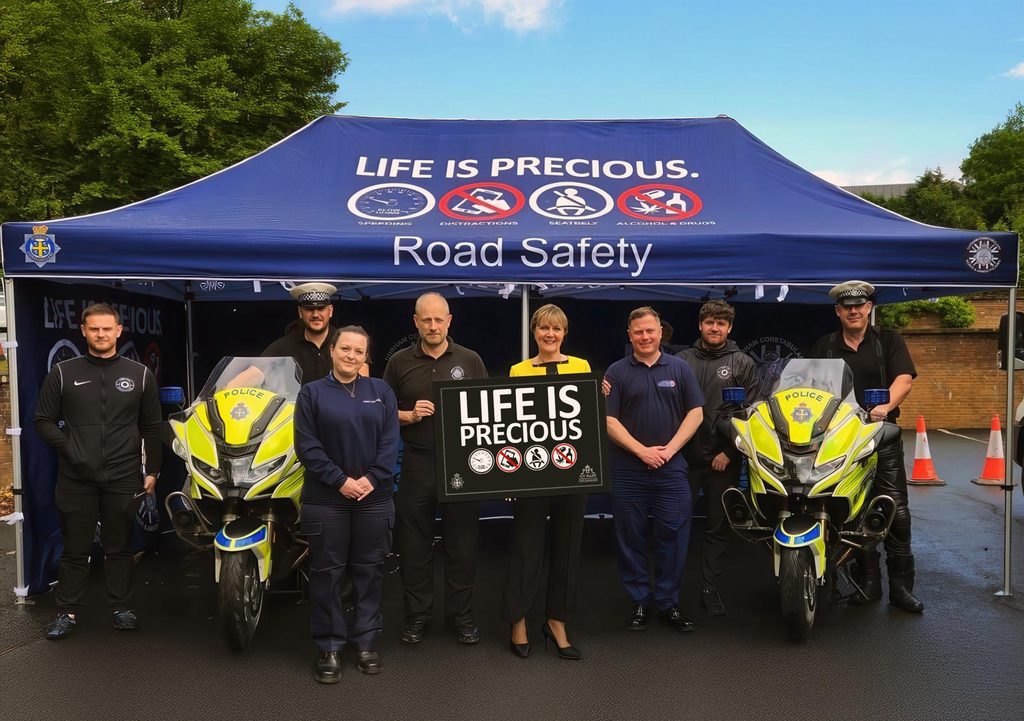
A new two-year trial is underway involving sophisticated technology that allows roads policing officers to target speed enforcement in high-risk areas before collisions occur.
Police and Crime Commissioner Joy Allen has provided £9k in funding for the Speed Compliant Tool (SCT) – a powerful online dashboard by tech firm Agilysis providing instant access to nationwide speed limit and average speed data to identify risk more effectively in County Durham and Darlington.
The platform enables roads policing officers to review speed data and non-compliance hotspots instantaneously rather than commissioning individual roadside surveys which can take several weeks to process and divert officers from frontline duties.
It will support the PCC’s mission to strengthen proactive and evidence-led approaches to tackle the Fatal 4 causes of fatal and serious injury collisions on the roads.
Traditionally, enforcement activity has focused on locations with an established collision history confirmed by data.
While this remains important, SCT enables roads policing officers to look beyond the historical data and identify roads where speeding behaviour is increasing before a significant collision trend develops, potentially saving lives.
Using multi-dimensional data mining and geo-spatial mapping, the software analyses speed, volume and risk factors and helps to highlight:
- Emerging speeding hotspots
- Roads with increased risk factors despite limited collision history
- Hotspots where community concerns align with intelligence
- Areas warranting proactive intervention to prevent casualties
A key advantage of the software is that it enables enforcement partners to stay ahead of the risk instead of reacting after serious collisions occur.
It also supports the deployment of mobile enforcement resources including camera vans to ensure they are positioned to where they can have the greatest impact on road safety.
Safer Roads is a priority in the PCC’s Police, Crime and Justice Plan and the Commissioner campaigns tirelessly to improve safety on the UK’s roads in her role as Joint Portfolio Lead for Roads Policing and Transport on behalf of the Association of Police and Crime Commissioners (APCC).
The Commissioner’s previous consultation findings show more than one in four residents (25.5%) believe roads policing should be a top priority for policing while speeding, drug/drink driving and dangerous driving also featured high on the list of concerns at 39%, 80% and 65% respectively.
Police and Crime Commissioner Joy Allen said: “I am pleased to fund this important software and increase our capabilities in preventing collisions. Advances in technology are crucial for enabling us to predict risk and take proactive action rather than reacting in the aftermath of tragedies. Such an approach has the potential to reduce future victims and spare families the agony of loss and for this reason alone this investment is worth every penny.
“Making our roads safer requires a whole-system approach. Alongside investing in new technology to maximise the impact of police time and resources, I continue to press the Government for substantial, long-term funding and resources to ensure forces can deliver new enforcement responsibilities proposed in the national Road Safety Strategy and upgrade their response to remain one step ahead of the risks. I am also lobbying ministers for stronger legislation and better education to change attitudes and challenge risk-taking behaviour behind the wheel as early as possible, recognising that solutions must reach across society.”
Inspector Andy Howarth, Strategic Roads Policing Inspector at Durham Constabulary Roads & Armed Policing, said: “Speeding remains one of the biggest concerns raised by residents across County Durham. Speeding is certainly one of our highest contributory factors when investigating Fatal and Serious Collisions. Agilysis speed compliance tool is designed to help police forces become more proactive and intelligence led in targeting speeding complaints, with a hope in reducing Killed and Serious Injury Incidents.”
Armed with the risk analysis, officers will target deployments to roads with persistent speeding concerns and emerging risk areas. This will include routes with vulnerable road users including pedestrians and cyclists and in communities where enforcement can help to reassure residents and encourage motorists to abide by the law.