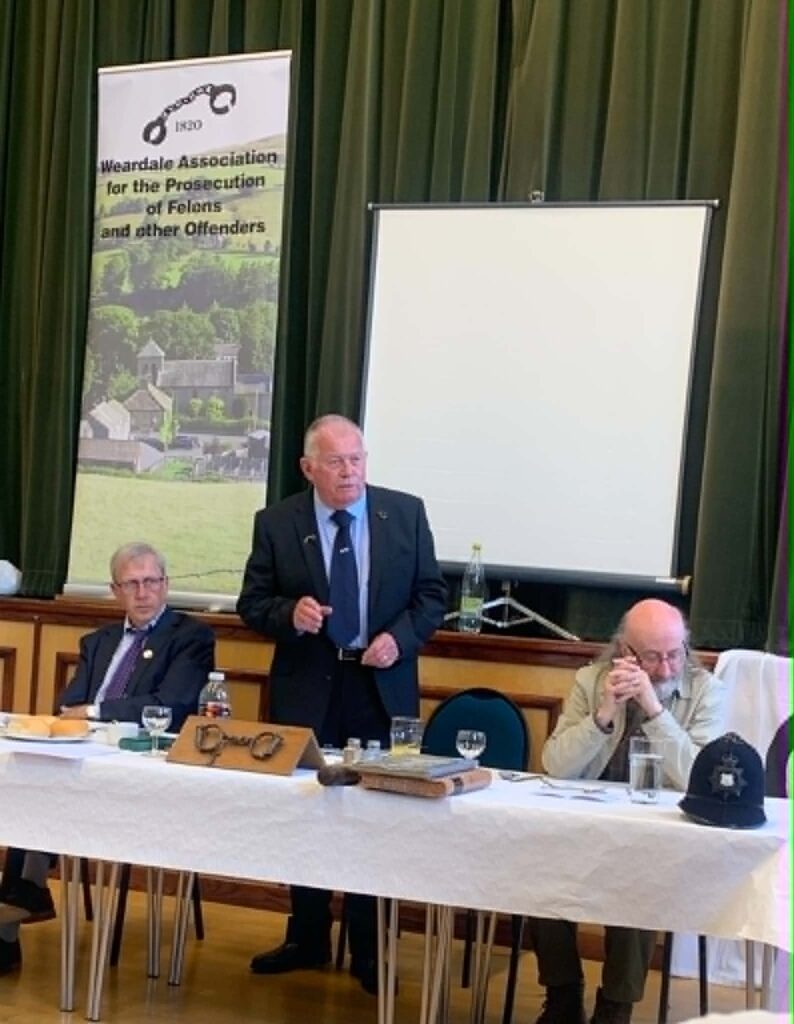
President Clement O’Donovan (centre) with Andrew Patterson, left and Terry Ashby, right.
IF you were the victim of a crime, you would expect the judicial process to begin, involving the police, the public prosecution service and the courts culminating in the various sanctions at the justice’s disposal. The current system has evolved from community law informed by Anglo-Saxon customs and Scandinavian legal traditions through centuries of Prince Bishops rule until their judicial powers were abolished in 1836.
It would be almost another three years before Police officers appeared and in fact, Durham Constabulary was formed in 1839 – even then only one policeman was assigned per 1000 head of population. In the Forest and Park of Weardale, at this moment the population numbers around 1500 and in 1820 it was around 5000 – rising to 6,500 by 1831. The world we see around us is definitely not overpopulated
However, Weardale led the Policing way and pre-empted the establishment of a Police Force. On Saturday 29th July in 1820, just five years after the Battle of Waterloo, according to a published sketch, a group of 37 men and one woman came together to create the Weardale Association for the Prosecution of Felons and Other Offenders. Not all that attended became members and George Crawhall of Newhouses became the first President. The members became the original Law Guardians in an area once described as ‘the lawless land’.
The Association members were commonly known as ‘The Felons’ even though its members were exactly the opposite. Their role was designed to hold those who broke the law to account. Long before Mr Robert Peel MP even thought of establishing a police force, the great and the good in the Upper Dale decided that lawlessness could not – and would not – continue in their area. And so it was that these men and one woman met in the upper room of the King’s Arms Hotel in St John’s Chapel and compiled a set of rules for the organisation. All were resident and probably worked or owned property in the ‘Park and Forest of Weardale’ – namely the 57 square miles West of Eastgate.
The minutes of that first meeting show thus:
‘We, whose names are hereunto subscribed, having met at the house of Joseph Dawson, Innkeeper of St John’s Chapel, in the chapelry of St John, Weardale, in the County of Durham , this twenty-ninth day of July, in the year of our Lord one thousand eight hundred and twenty to constitute and establish an association for the prosecution of felons and offenders of every description, from or against persons or property of us ,or any of us, do unanimously agree to enter into an association for the protection of our persons and property, at our equal and joint expense; and to bring all persons guilty of murder, robbery, burglary, larceny, petty theft or any other criminal act, offence or misdemeanour whosoever against persons or property of us, or any of us, to such punishment as by law is provided for the crime, offences and misdemeanours of which he, she or they shall be found guilty. And we hereby bind ourselves subject to the following resolutions and rules.
The rules covered the endeavours to instil a doctrine of Temperance in the minds of people and for the annual meeting to start promptly at the stroke of the church clock at 6 pm. There was one occasion where the clock was outrageously wrong being ten minutes fast! Three members were fined two shillings and six pence each for being late. The fines were later remitted and the Vicar Rev J Pattison offered to keep the clock as right as possible in future.
From 1820, Weardale was at the forefront of crime-fighting and offences were dealt with by ‘The Felons’ who brought perpetrators to boot. So called ‘petty’ offences, including assault and battery, garden-breaking, vandalism, breaking down fences, drunk and disorderly, wife-beating, theft of horses, poultry, beer, meat and cruelty to animals. The playing of football or other unlawful games was considered to be a fractious pastime, unruly because the rules of the game were not established until 1850.
Rewards were offered for information and punishment was meted out. The Felons very soon became a terror to wrong-doers who were very glad to be given the opportunity to apologise, pay fines and give a promise of good future behaviour. Other, more serious, offenders were locked up and taken to the magistrates or ‘quarter sessions’ (Crown Courts) and the last time the ‘Felons’ prosecuted anyone was in 1928.
Nowadays the Felons event is a purely social affair, meeting once a year on the last Friday in May at St John’s Chapel Town Hall, for dinner with a guest speaker.
Any members arriving after 6 pm by the church clock are fined half a crown!
This year the meeting was opened by current President Clement O’Donovan, who was aided by Secretary, Andrew Patterson and Treasurer, Athol Graham. He made a welcome address followed by the Roll Call. The meeting followed much the same procedure as that of 1820. He used a wooden gavel that has been in use since it was made from part of an oaken railway line which once bore trucks in and out of Killhope Mine. The top table was adorned by a pair of policeman’s helmets. The table also held a pair of old handcuffs – and there is a story behind those too. Joshua Dawson, the licensee of the King’s Arms was appointed ‘Constable’ by the Association in 1827 long before the Dale ever had a Police Constable. At some point, he was issued with handcuffs in which to keep offenders under control before he locked them in the upper room of the premises. The story goes that one of these offenders managed slip the handcuffs off and leaned out of the window, hanging them on to a nail that was there. They remained in that position, it is said, for around 20 years but are brought out every year for this meeting.
Following the roll call, Grace is read and Dinner served. Members enjoyed a delicious, home-cooked, three-course meal supplied by Jane Coates from the Langdon Beck Hotel.
Dinner provides the opportunity for members to speak to those they have not seen since last year’s meeting.
Following dinner, the minutes and the treasurers accounts are read and approved.
This is followed by the reading of the minutes from the 1926 and 1976 meetings. Clem described key events that were taking place in the world at those times and some these events had an impact upon the members at that time.
Nominations and ballots then take place for the election of officers for 2027 and also for the Association committee, elected every year, from members who reside in the Park or Forest. The committee is chosen by lot in the time old fashion of selecting pieces of paper from the police officer’s helmet.
Membership was originally open only to residents in the Park and Forest (the membership was widened at some point to include those from within the confines of Weardale itself – down to the border just before Witton-le-Wear).
After the elections of officers and committee a list of proposing Toasts are called starting with the reigning Monarch, the Association, Weardale and New Members. The list is paused for the guest speaker who this year was Terry Ashby who lives in Westgate. He brought along a slide show and spoke about his adventures in South America as a younger man. It was a fascinating and insightful talk. The toasts conclude with a vote of thanks to the ‘Officers’ and finally, by Clem to ‘Absent Friends’. The members then stood to link arms to sing ‘Auld Lang Syne’ and the 204th annual meeting was at its end.
To some the Association of Felons might appear as an anachronistic organisation but the membership shares the belief that ethics and the principles of justice do not change with the calendar and the passing of time.
The Felons meeting and annual dinner is much more than a social event where members ‘share a glass and a pipe’. It is an acclamation that justice and due process is just as important today as it was over 200 years ago when the Association was formed. Our heritage and values inform the code and standards we live by and pass on to future generation. Just like those 37 men and one woman did so back in July 1820.