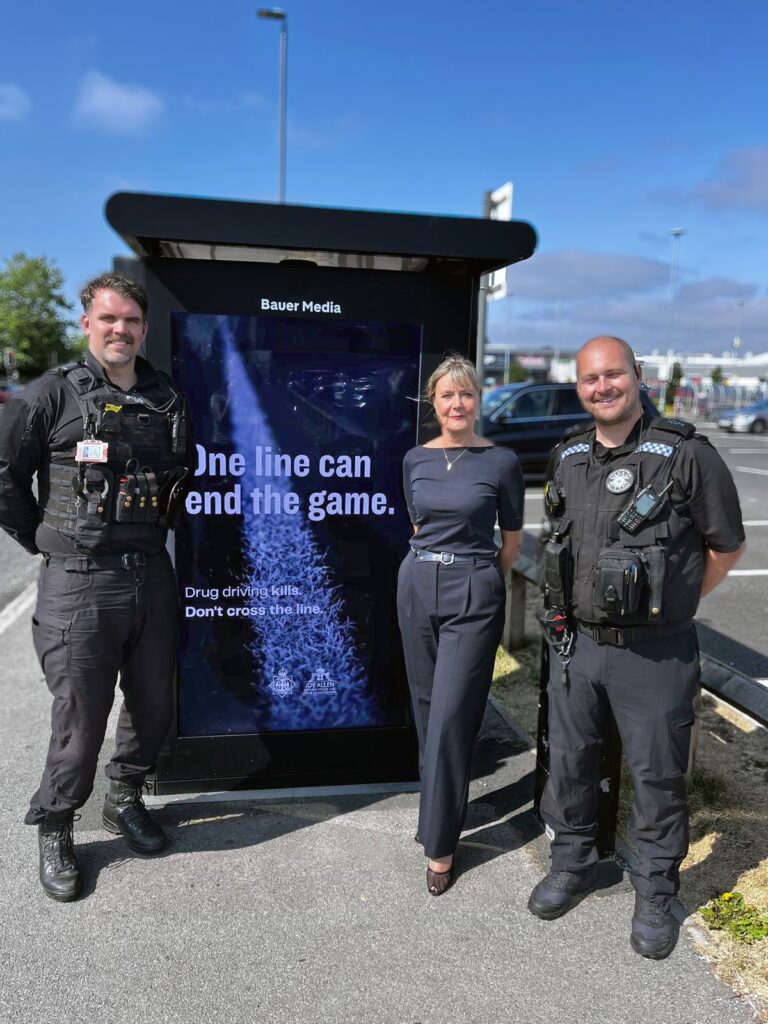
Leading road safety campaigner and Durham Police and Crime Commissioner Joy Allen has joined forces with Durham Constabulary and Darlington Borough Council’s Community Safety Team to challenge dangerous attitudes towards drink and drug driving.
Ahead of the World Cup, the PCC partnered with the force and Community Safety Team to deliver a high-profile World Cup-themed road safety campaign across County Durham and Darlington. Featuring eye-catching graphics displayed in pubs, bus shelters and on billboards, the campaign warned motorists of the life-changing consequences of driving under the influence.
Alongside the awareness campaign, Durham Constabulary carried out targeted enforcement activity, resulting in 113 motorists being caught driving under the influence of drink or drugs despite repeated warnings:
- 42 were arrested for drink driving
- 49 were arrested for drug driving
- 22 failed to provide a sample
Several offenders have already been charged, with further cases continuing through the criminal justice system.
The results highlight the scale of the problem locally and reinforce the need for continued enforcement and education to prevent motorists from putting lives at risk.
In addition, Joy Allen is now backing the Government’s THINK! ‘Don’t put drugs in the driving seat’ campaign, which targets 17 to 29-year-olds through posters, social media, online platforms and audio channels throughout July and August.
Research commissioned by THINK! suggests drug driving is becoming increasingly normalised among some young men. The campaign found that 41% believe it is acceptable to drive after taking drugs if they ‘feel fine’, while more than half (51%) know someone who drives after using drugs.
The findings also expose persistent myths around drug driving, including beliefs that cannabis can improve driving ability by making drivers more cautious, or that cocaine can offset impairment and make someone safe to drive. The campaign challenges these misconceptions by highlighting the reality that drugs can continue to affect reaction times, coordination and judgement long after the initial effects appear to have worn off.
The initiative also encourages driving instructors to reinforce these messages with learner and newly qualified drivers, helping them understand the legal, personal and potentially devastating consequences of drug driving.
As the Association of Police and Crime Commissioners’ joint national lead for Road Safety and Transport, Joy Allen has made safer roads a key priority. Through her Police, Crime and Justice Plan, she has committed to reducing deaths and serious injuries on the roads, increasing enforcement activity and supporting measures that tackle dangerous driving behaviours.
Police and Crime Commissioner Joy Allen said: “The results of our World Cup road safety campaign show that too many people are still willing to take the risk of driving after consuming drink or drugs, despite the well-publicised dangers and consequences.
“While enforcement remains a crucial part of our approach, education and prevention are equally important. THINK!’s research exposes some deeply worrying misconceptions around drug driving, particularly among younger drivers, and these myths must be challenged.
“Driving under the influence of drugs puts everyone at risk. It affects judgement, reaction times and concentration, and the consequences can be devastating for victims, families and communities.
“These campaigns have provided the opportunity to reinforce the message that drug driving is not only illegal, but dangerous. Through continued enforcement, education and partnership working, we will continue to do everything we can to make our roads safer.”
Among her road safety commitments, the PCC is also supporting the expansion of workplace drug and alcohol testing, advocating for a lower drink-drive limit in England, and seeking increased capacity for drug-driving enforcement and testing across the region.