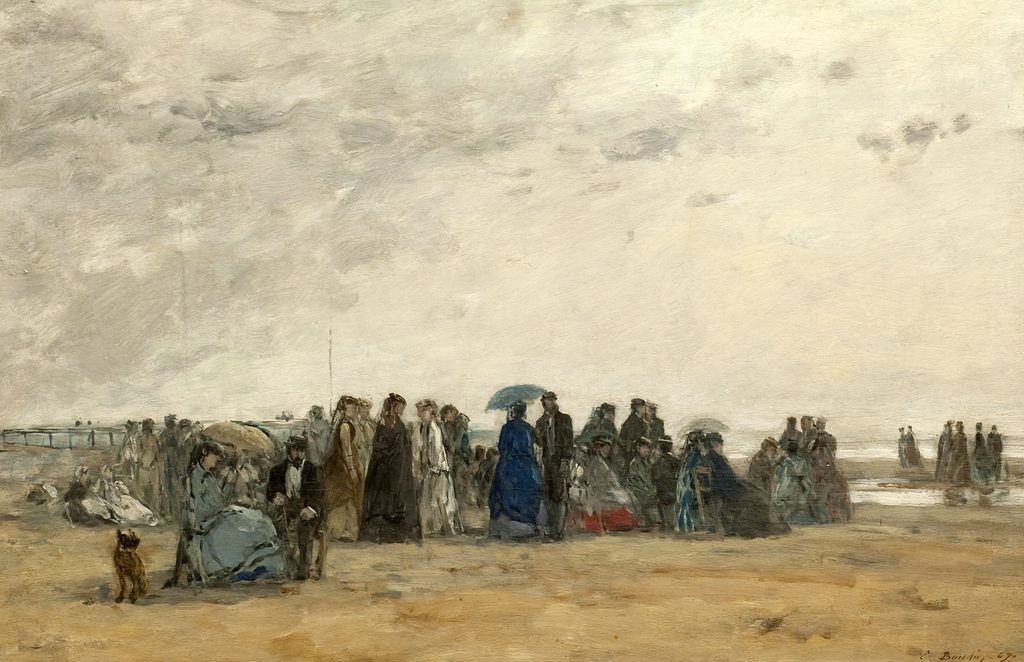
Eugene Boudin ‘Beach Scene at Low Tide’
The Bowes Museum presents Impressions of Light: Masterpieces from MuMa Le Havre and
The Bowes Museum, a major exhibition tracing the evolution of landscape painting from
pre-Impressionism to post-Impressionism.
Marking a significant international partnership with the Musée d’art moderne André
Malraux (MuMa), the exhibition brings works by artists including Claude Monet (1840
1926), Eugène Boudin (1824–1898), Gustave Courbet (1819–1877), Camille Pissarro (1830
1903), Jean-Francis Auburtin (1866–1930) and Raoul Dufy (1877–1953) from France to
Barnard Castle, with many on display in the UK for the first time.
Displayed alongside The Bowes Museum’s pioneering collection of pre-Impressionist
works, these paintings show how artists began to depict landscapes in new ways, using
colour, light and atmosphere to capture a sense of place. Presented in themed groupings,
the exhibition echoes the coast, cliffs, moorland and dales surrounding the museum,
connecting French visions of light and place with the landscapes of County Durham.
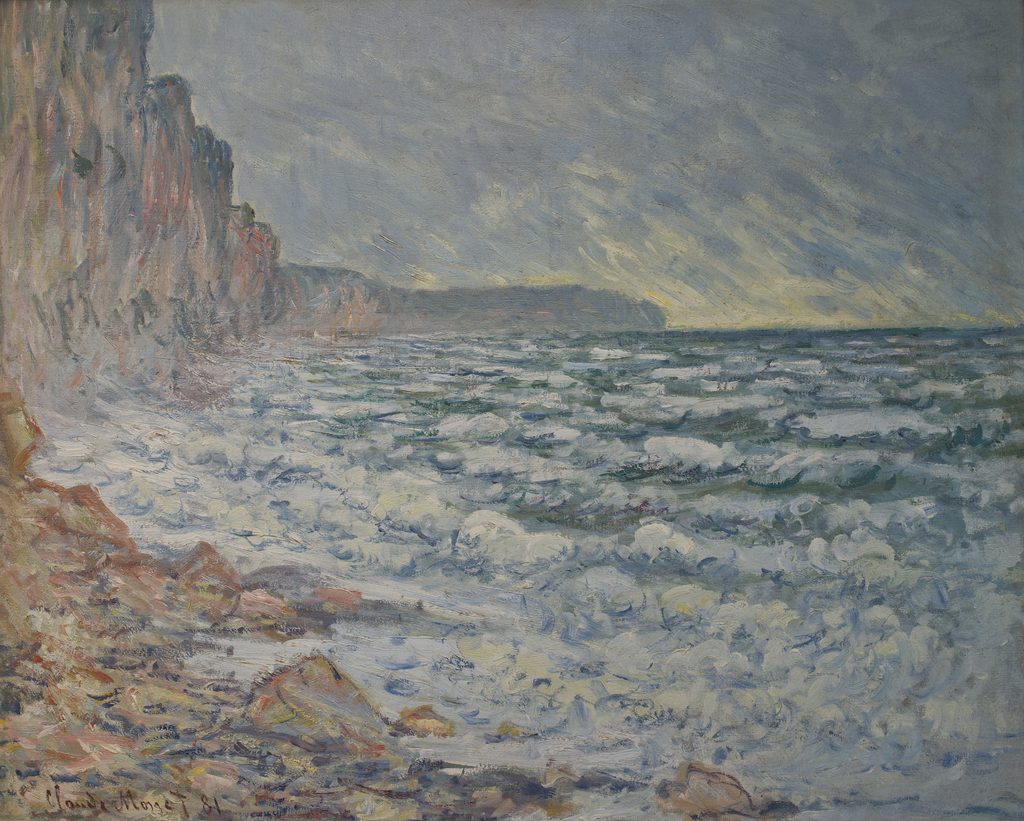
Claude Monet
The Bowes Museum’s founders, Joséphine (1825–1874) and John Bowes (1811–1885),
were deeply connected to the French art world and unusually for the time, collected
works by living French artists. During the 19th century, Le Havre’s position as an
international port fostered an extraordinary artistic culture. The couple frequently visited
Le Havre, reflecting their strong ties to the birthplace of Impressionism, while the design
of The Bowes Museum was inspired by the city’s town hall. The first section of the
exhibition explores how the social and cultural conditions of Le Havre encouraged radical
artistic developments. Eugène Boudin’s intimate harbour scenes are shown alongside
views of Le Havre’s expanding docks and factories by Raoul Dufy, Gaston Prunier (1863
1927) and Maxime Maufra (1867–1918).
The second section of Impressions of Light explores how painters in the 19th century
turned their attention to fields, farming and the countryside. Artists in this section
including Pierre-Henri de Valenciennes (1750–1819), Georges Michel (1763–1843), Gustave
Courbet (1819–1877) and Eugène Boudin (1824–1898) chose to paint familiar scenes,
moving away from traditional heroic subject matters. This section is concluded by
Boudin’s studies of cattle, which reflects a growing fascination with the effects of light and
weather on the landscape.
The next section explores how this focus on the dynamic qualities of landscapes grew
further. Armand Guillaumin (1841-1927), returned to the same rocky viewpoint at Crozant
repeatedly across different seasons, depicting how the river, vegetation and stone
changed in arrangements of vivid colour and shifting light. Works by Camille Pissarro
(1830–1903), Henri-Edmond Cross (1856-1910) and Jean-Francis Auburtin (1866-1930)
demonstrate how landscape was no longer simply something to be observed, but
something felt through a combination of memory, sensation and light.
Along the Normandy coast, where the sea and weather were constantly shifting, artists
found a landscape that could never be captured in a single moment. The fourth section of
Impressions of Light explores this phenomenon. In Fécamp, Seaside, 1881, Claude Monet
(1840–1926) captures the ever-changing landscape using colour, movement and light to
connect the cliffs, sea and sky. This sensitivity to the changing nature of the coast has a
particular resonance in County Durham, where limestone cliffs, sandy bays and wide
North Sea skies create a continually changing landscape.
As 19th-century France expanded and transformed through industrialisation, artists were
drawn to landscapes with signs of movement, labour and trade. In Paris, the Outlying
Boulevards (1856), Alexandre René Véron (1826-1867) dates captures the city extending
beyond its historic boundaries. Elsewhere, artists including Charles-François Daubigny
(1817-1878) dates and Alfred Sisley (1839-1899) dates found quieter forms of transition in
rivers, pathways and settlements. County Durham’s landscapes are shaped by a similar
layering of time, where traces of farming, industry and settlement remain visible within
the land itself. The works in this final section reflect the wider experience of the 19th and
early 20th centuries, when new ways of living changed both the landscape and how artists
responded to it.
2
From cultivated fields and moorlands to coastlines and settlements, Impressions of Light
reveals the gradual transformation of landscape painting: from close observation of the
natural world to a more personal and expressive response to place.
Hannah Fox, Executive Director, The Bowes Museum comments: “Impressions of Light:
Masterpieces from MuMa Le Havre and The Bowes Museum brings together over 60 works
from the collections of Barnard Castle’s Bowes Museum and Musée d’Art Moderne André
Malraux (MuMa), in Le Havre, Normandy, many of which have never been seen before in
the UK. In doing so, it doesn’t simply create a dialogue between our two museums; it
restores a connection between two worlds.”
Vicky Sturrs, Director of Programmes and Collections at The Bowes Museum, says: “For
much of the 19th century, the landscapes of northern France became a testing ground for
modern painting. As artists moved between forests and fertile valleys, windswept cliffs
and expanding ports, they developed new approaches to capturing light, atmosphere and
life itself. Landscapes were not simply subjects to be painted, but places from which a
transformational, new visual language emerged.
Impressions of Light brings this story to Britain through a partnership between MuMa Le
Havre and The Bowes Museum. While the paintings were made in Normandy, Île-de
France and along the French coast, many of the landscapes they depict find unexpected
echoes in County Durham. This exhibition also pays homage to Joséphine Bowes and her
mould-breaking artistic patronage, uniting her pre-impressionist collection with the
avant-garde works she might have acquired had she lived beyond 1874.”
Géraldine Lefebvre, Curator, Director of MuMa: “Museum collections often tell much more
than the history of the works themselves. They carry within them the journeys of those
who built them. The exhibition Impressions of Light: Masterpieces from MuMa Le Havre
and The Bowes Museum is part of this history. It re-establishes an old link between two
territories, Normandy and North East England, united in the 19th century by the singular
destiny of Joséphine and John Bowes. ”
Michaël Debris, Assistant Curator at MuMa: “The collaboration between our two museums
has its roots in a longer history. In 2016, the MuMa exhibited two works from the Bowes
Museum collections as part of an exhibition dedicated to Eugène Boudin. Monet’s
“Fécamp, Seaside” is returning to Britain twenty-two years after the Bowes Museum first
requested the loan of this painting for an exhibition on landscape painters in Normandy.
As the painting was involved in another project at the time, the painting could not be
loaned then. But now it has finally happened!”
Presented by The Bowes Museum and MuMa – Musée d’art moderne André Malraux, Le
Havre and co-organised with Manifesto Expo.