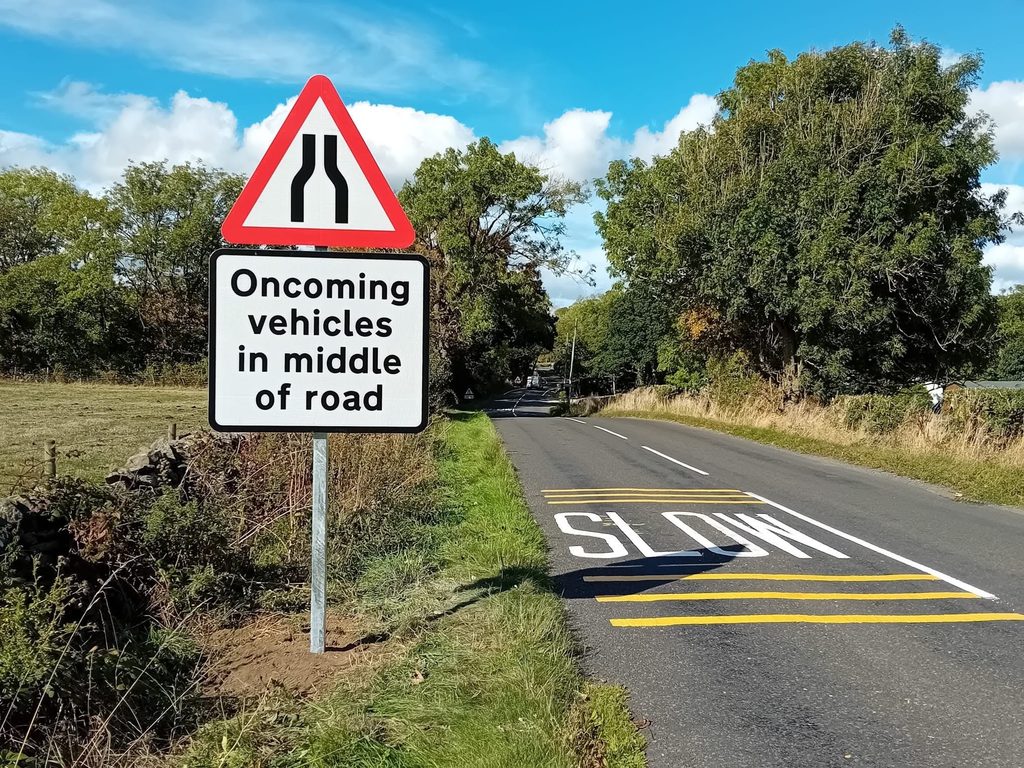
New photographs taken today show the recently installed traffic-management measures at Linburn Beck Bridge on the C30/Daniel Lane route. The changes are significant: • New “ROAD NARROWS” warning signs
• New plates stating “ONCOMING VEHICLES IN MIDDLE OF ROAD”
• New SLOW markings and warning bars
• The centre white line has been deliberately removed through the constrained bridge section
• No formal priority system is apparent
• No new reduced speed limit is apparent
• The bridge itself has not been widened
The wording of that new sign matters. Department for Transport guidance says “Oncoming vehicles in middle of road” is used where a physical restriction requires large vehicles to travel in the middle of the road over a short distance. DfT guidance also specifically recognises situations where narrowing is so significant that the centre-line marking has to be omitted.
So this is no longer simply residents saying Linburn Bridge is constrained.
DCC’s own new traffic-management scheme now visibly recognises that vehicles may have to use the centre of the carriageway.
But warning drivers of the conflict is not the same thing as resolving it.
There is still an obvious question: WHO GIVES WAY WHEN TWO LARGE VEHICLES MEET?
A formal priority arrangement is available under the traffic-sign regulations — the regulatory “give priority to vehicles from the opposite direction” system — but no such priority control is visible in the new arrangement.
That becomes particularly important because: C31 Crakehill Bank is proposed for permanent closure, making the C30/Daniel Lane/Linburn route part of the permanent access arrangement towards Hamsterley.
The route is also the confirmed haulage route for the forthcoming Paddy’s Plantation timber operation, involving approximately 880 tonnes of roundwood and repeated loaded and empty articulated timber-wagon movements.
And this same corridor is being relied upon in considering the additional operational and construction traffic associated with DM/24/02979/FPA – Hamsterley Forest Masterplan.
THE QUESTION FOR DCC IS NOW VERY SIMPLE
What assessment demonstrates that opposing large vehicles can safely negotiate this section when DCC itself is warning that vehicles may have to travel in the middle of the road?
Where is the swept-path/vehicle-tracking assessment?
Where is the assessment of a loaded 44-tonne timber wagon meeting an empty returning articulated wagon? Why is there no defined priority hierarchy?
And how has this been assessed alongside the permanent C31 diversion and additional Forest development traffic?
New signs may warn motorists about a constraint. They do not create additional road width or capacity.
That is the evidence we will now be asking Durham County Council Highways to provide.
Concerned Hamsterley Resident.